
Cyprus employers with teams abroad: the risks most companies miss, and how to fix them
Hiring overseas or supporting an employee’s move abroad? Kleos explains the risks Cyprus employers should consider, from local employment rules to contractor classification, and compares the available hiring options.


By Kleos | Partner contribution
This article was contributed by Kleos, Ergodotisi’s partner specialising in international employment and contractor management.
Only around 22,000 people in Cyprus were out of work in August 2026, an unemployment rate of 4.1% against an EU average of 6.1%. So when the right person for a role lives in Belgrade or Warsaw, more Cyprus companies say yes, and a new set of rules comes with that yes.
Remote and hybrid work speed this up. Sooner or later, "remote" stops meaning "from home in Limassol" and starts meaning "from Athens", "from Belgrade" or "from Lisbon". A valued developer follows their partner abroad. The specialist you couldn't find on the island turns out to live in Poland. A freelancer you brought in for one project slowly becomes a core member of the team.
Each of these situations is manageable. Each one also changes which country's labor law, tax rules and social security apply, and many employers only find that out after the fact. This guide covers what changes when your team works from other countries, where the risks are, and how Cyprus companies can set things up properly from day one.
Why this matters now for Cyprus employers
A market this tight changes how companies hire. The Ergodotisi Job Seekers Pulse 2026 shows what that looks like: most candidates already have a job, and 46.7% of respondents prefer hybrid or some form of remote work.
International companies in Cyprus have a second date to keep in mind. Companies registered through the Business Facilitation Unit committed to having at least 30% Cypriot or EU staff within five years of registration. From January 2, 2027, the Migration Department will look at that 70:30 ratio when it reviews work permits for new hires from outside the EU. A company below the ratio isn't automatically blocked, but its applications are expected to be assessed case by case.
Both trends point the same way. Companies will keep hiring Cypriot and EU talent locally, and for roles they can't fill that way, more of them will employ people in the country where those people already live.
Three ways Cyprus companies end up with people abroad
In our conversations with Cyprus-based companies, it usually starts in one of three ways: a team member wants to move abroad, the skills you need aren't on the island, or a long-term freelancer has slowly become part of the team. The next sections cover each one, with a real example.
When an employee works from another country
Once an employee lives and works in another country for longer than a short trip, that country's rules usually start to apply, whatever the contract with the Cyprus company says. In most cases this affects four things:
- Labor law. Notice periods, paid leave, bonuses and termination rules follow the country where the person works, and local protections can't be signed away. In Greece, for example, salary is paid 14 times a year, the employer adds 21.79% social contributions on every payment, and after the first year severance runs from two to 12 months of pay, as our Greece hiring guide breaks down.
- Income tax. Many countries treat someone as a tax resident after 183 days in a year, and from then on the employer may have to withhold and report tax locally. An employee who spends more than 183 days a year in another country usually stops being Cyprus tax resident, along with the Cyprus tax benefits that came with it.
- Social security. Within the EU, an A1 certificate (the EU form that confirms where social security is paid) can keep a posted employee in the Cyprus system for up to 24 months. A permanent move means contributions in the new country, and outside the EU it depends on bilateral agreements, so coverage varies a lot.
- The company's own tax position. This matters most for senior people. A sales director who regularly signs contracts from Athens can create a permanent establishment for your company in Greece, with corporate tax to match. Companies that rely on Cyprus tax residency also need to keep real management on the island.
Some of these rules apply after a set number of days, others from day one, and the thresholds differ by country. So it pays to decide how the person will be employed before they move.
Case: from Serbia to Japan
Earlier this autumn, an engineer at a Cyprus-headquartered company, then living in Serbia, wanted to relocate to Japan. To keep him, the company needed a Japanese employment contract, a work visa and local payroll, and only the employer, not the engineer, could pay for the setup. Doing it through an EoR (Employer of Record) meant the company didn't have to open a Japanese entity for one person.
Letting people go because they move is expensive in this market. The Ergodotisi Job Seekers Pulse found that 88.9% of respondents are open to a new role, so a strong employee who leaves Cyprus will have offers quickly.
When you work with a contractor abroad
Working with a contractor in another country is simpler, because the contractor runs their own business and pays their own taxes. A few things still need attention on the Cyprus side:
- A clear contract. It should describe the services, the deliverables and how the work is paid, and it should match what the person actually does. Banks check this too: if the contract says "logistics management" and the invoices say "software development", expect questions.
- Intellectual property. In many countries the person who creates code, designs or texts owns them by default. Without an assignment clause that holds up under the contractor's local law, part of your product may legally belong to the people who built it.
- Invoices and documents. Banks on both sides may ask what a payment is for, and transfers to some regions are checked more often than others. Invoices that match the contract and the contractor's registered activity make those checks much faster.
- Payout routes. One Cyprus software company we spoke with pays around 30 contractors in several countries through one payment provider. After a transfer was frozen for a week, the company started looking for a backup way to pay, because one stuck payment had put the whole setup at risk.
The contractor model fits project work and people who run their own practice with several clients. It gets much harder to defend once the relationship starts to look like employment.
The grey zone: when a contractor is really an employee
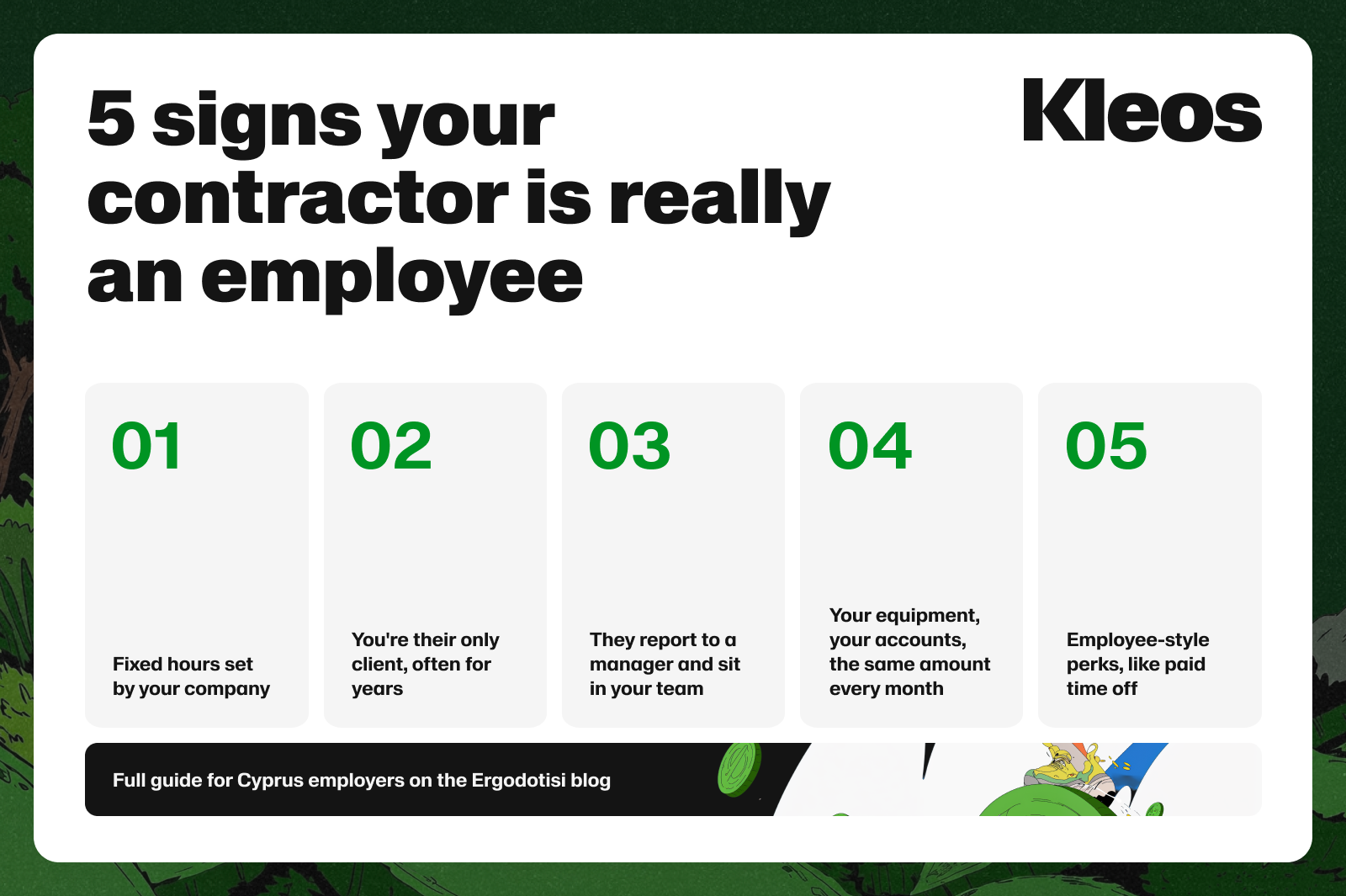
Tax and labor authorities judge a working relationship by how the work is actually done, whatever the contract calls it. The tests vary by country, but the same signs tend to raise questions:
- the person works fixed hours set by your company;
- your company is their only client, often for years;
- they report to a manager and sit inside your team structure;
- they use your equipment and accounts and receive the same fixed amount every month;
- they get perks that look like an employee's, such as paid time off.
If a contractor is reclassified as an employee, the company may owe back taxes and social contributions, penalties, and the rights the person should have had all along, such as paid leave or severance.
Companies usually notice this risk once the team has grown.
Case: 50 contractors and a growing risk
One company invoicing from Cyprus works with about 50 contractors and wanted to lower the risk of those relationships being treated as employment. It started moving them to a Contractor of Record, which holds the contracts and takes on the misclassification risk.
Sometimes the choice is made for you.
Case: when insurance rules out contractors
One regulated Cyprus-based group we spoke with has around 40 people across five countries. Its professional indemnity insurance only covers people working under the company's supervision, so contractors weren't an option and the team had to be employed in each country.
How a Cyprus company can employ someone abroad: four options
There are four common ways to work with people outside Cyprus, and most growing companies use more than one.
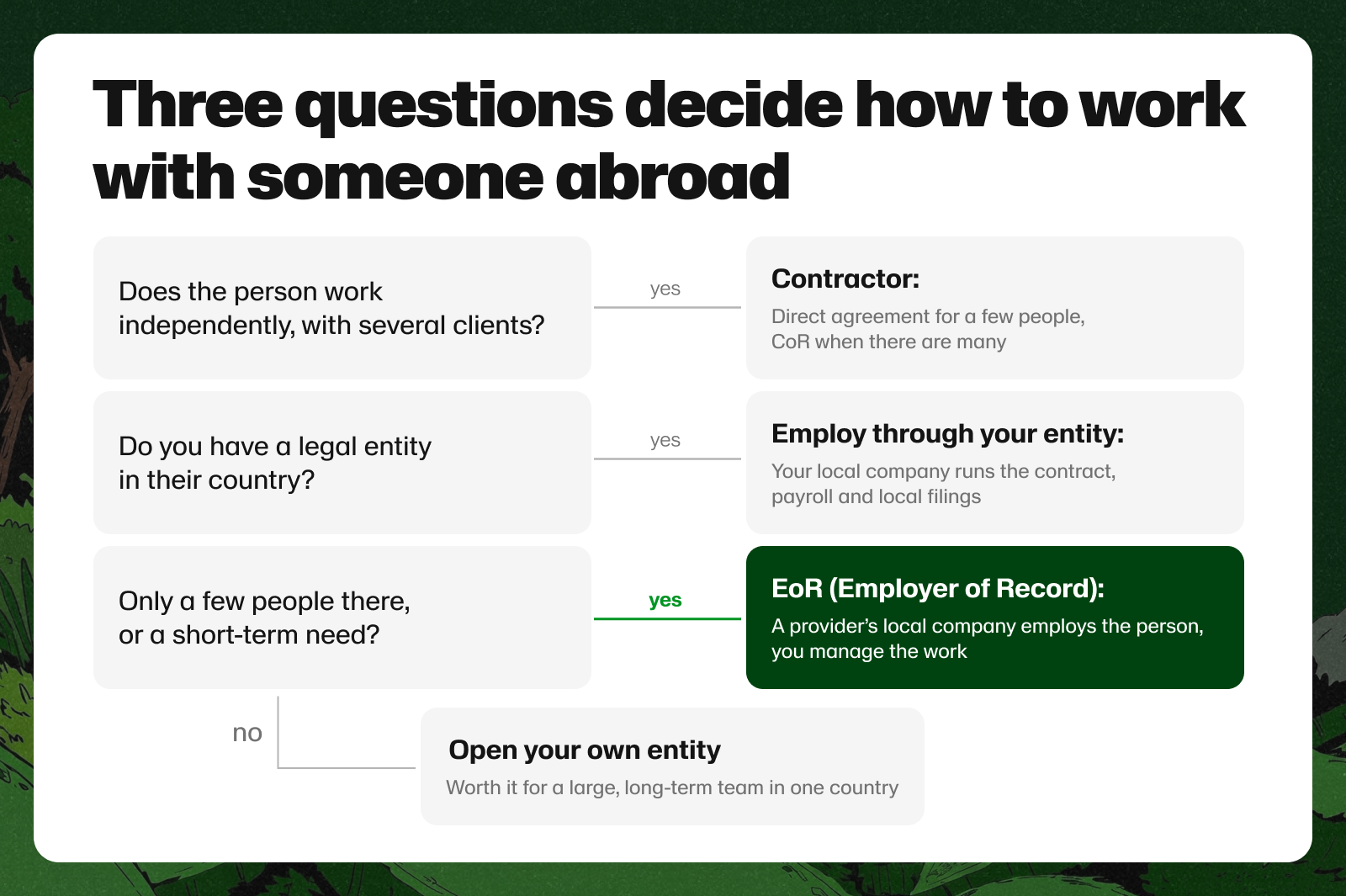
The answer can differ from person to person, so most companies end up with a mix of these setups.
Many companies move through these stages as they grow: direct contractors first, then EoR as people ask for formal employment, then their own entity once a country has enough people to justify it.
Kleos runs both EoR and CoR in 200+ countries and helps decide which model fits each role and country before anything is signed. If you're weighing a specific country, our global hiring guides cover employer costs and local employment rules country by country.
A checklist for Cyprus employers with people abroad
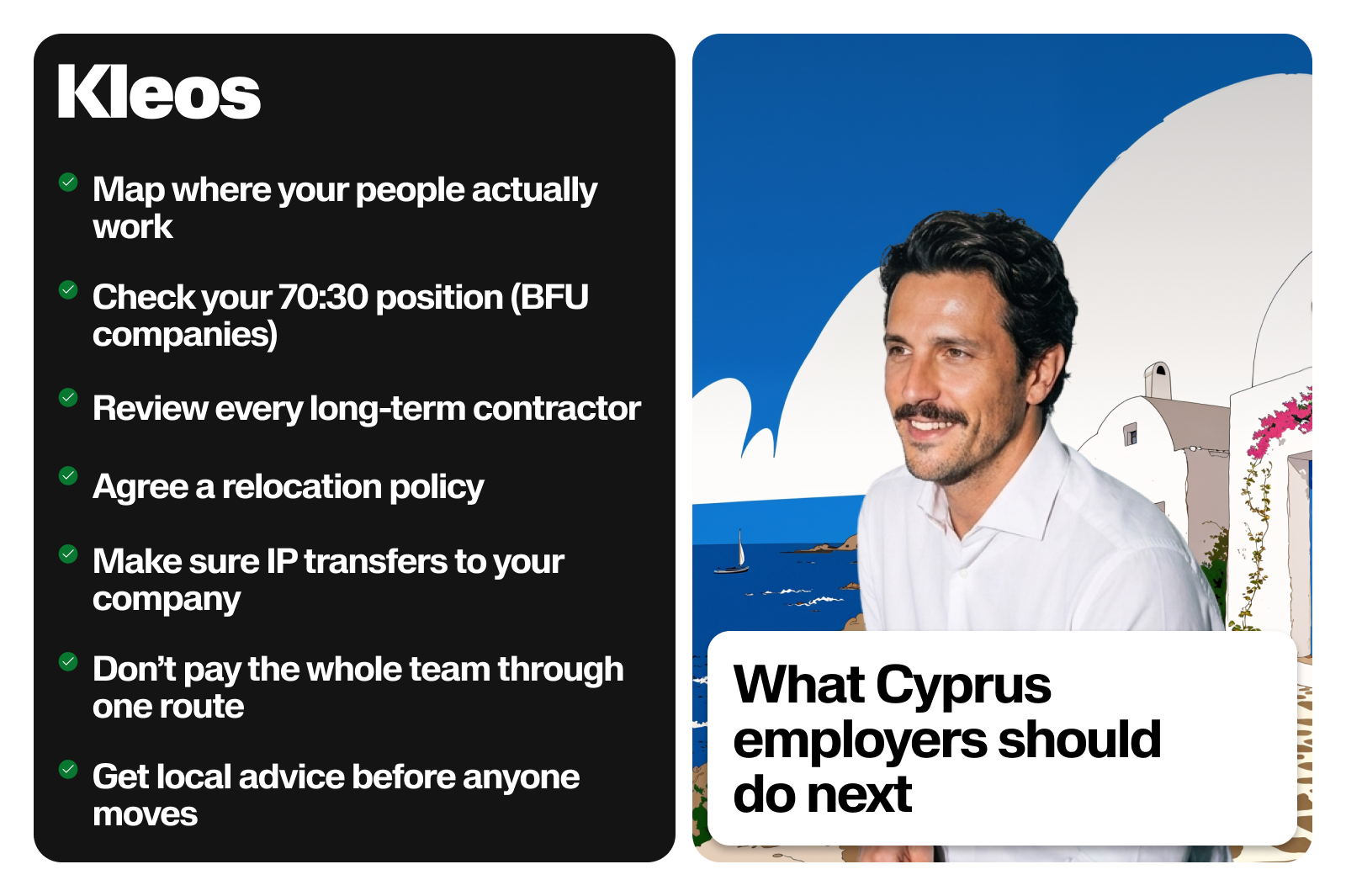
- Map where your people actually work. List everyone by the country they live in, not the country on their contract, and note how long they've been there.
- Check your 70:30 position. If your company is registered with the Business Facilitation Unit, see where your ratio stands before you plan non-EU hires for 2027.
- Review every long-term contractor. For each one, check hours, clients, reporting lines and equipment against the signs above, and decide whether the relationship should stay a contract.
- Agree a relocation policy. Decide in advance what happens when someone wants to move: which countries you support, who pays for visas, and how the person will be employed there.
- Fix IP and documents. Make sure every contract transfers IP to your company and that invoices match the work being paid for.
- Spread your payment risk. Avoid paying the whole team through a single route that can be held up by one bank.
- Get local advice before a move. Labor and tax rules differ by country, so check the specific case with an adviser or your EoR provider before the person relocates.
Frequently asked questions
Can a Cyprus company employ someone who lives in another country?
Yes. The company can open its own entity in that country, use an Employer of Record that employs the person locally on its behalf, or work with the person as an independent contractor if the work really is independent. Employing someone abroad directly from Cyprus usually means registering as an employer in their country.
What is an Employer of Record?
An EoR (Employer of Record) is a provider whose local company becomes the legal employer of your team member. It handles the employment contract under local labor law, payroll, income tax, social contributions and statutory leave, while you manage the person's day-to-day work. Providers such as Kleos offer EoR in 200+ countries.
What is the difference between EoR and CoR?
EoR is for employees: the provider employs the person and runs payroll and benefits. CoR (Contractor of Record) is for contractors: the provider contracts with the person, collects documents and handles payouts, and takes on the misclassification risk.
What happens if an employee moves abroad and keeps working remotely?
The new country's labor, tax and social security rules usually start to apply, sometimes after a set number of days and sometimes from day one. The simplest way to keep the person is to employ them in the new country through your own entity or an EoR.
What is the 70:30 rule for companies in Cyprus?
Companies registered through the Business Facilitation Unit committed to having at least 30% Cypriot or EU staff within five years. From January 2, 2027, the authorities will consider that ratio when reviewing work permits for new non-EU hires.
About Kleos
Kleos helps companies build international teams without the legal and administrative overhead. Through its Contractor of Record and Employer of Record services, businesses can hire and pay people in 200+ countries without setting up local entities. Kleos takes care of compliant contracts, local payroll, taxes, benefits and payouts in local currency. Everything runs through one contract, one invoice and one dashboard. More than 600 teams already use Kleos to manage their distributed workforce.
Learn more at kleos.io.